It’s the people, stupid
We believe in nothing, except pettiness.
Here’s a question, for the second half of March: If you’re watching a game between two teams that you don’t like, who do you root for?
I mean, it’s simple:
If one team is good and the other is bad, you root for the good one. Because nobody is that happy about winning a game they should win. The good team wins; their fans feel a little satisfied; the bad team loses; their fans feel a little disappointed; a boring game, signifying nothing. But if the bad team wins, they’ll celebrate. They’ll storm the court. They’ll gloat on the internet. They’ll save their season. Some awful highlight will become a permanent fixture on top ten lists, and you’ll never be able to escape it. No—much better for nothing to happen, and everyone to forget the whole thing as quickly as possible.
You want the game to be close, though. You want the bad team to almost win, and then have their hearts ripped out. Undeserved relief for the favorites; heartbreak from the underdogs. Lots of sound and fury, getting this close to immortality, still signifying nothing.
But it’s delicate. If one team wins in spectacular fashion, snatching victory from the jaws of defeat, you’ll have to put up with another inescapable highlight. But if a team loses in spectacular fashion, fumbling away an easy victory in some stunningly catastrophic way, you might get a highlight, a meme, and an entire oral history of the trouble.
If both teams are good, you root for the underdog. Sure, they’ll be happy about winning, but probably not as disappointed as the favored team that lost. That team was playing for something; they were in the hunt; they were title hopefuls. Much better to regress everyone to the mean—both teams being pretty good is not nearly as annoying as one of them being great.
If both teams are bad, you also root for the underdog. Have the bad team drag the slightly better team down a little further into the mud.
Unless—if one of the teams is historically bad, you root for that team to lose. Spend them spiraling toward new lows. Having to watch a team you hate win a meaningless game is a small price to pay for desperate headlines about terrible, horrible, no good, very bad seasons.
Finally, all of this is overridden if the game is particularly significant for one team—if they’re trying to clinch a division; if it’s senior night; it’s the final game in a famous coach’s 42nd season against a hated rival in their first-ever meeting in the Final Four.
I know, I get it, all of this is very petty and dumb. But being a sports fan, as a general rule, is very petty and dumb. We don’t play on the teams; we often don’t live in their cities; we didn’t always go to their schools. We get nothing if “our” team wins; we lose nothing if they don’t. We pick meaningless allegiances based on where we grew up, or where our parents grew up, or who they liked, or who they didn’t like, or which players we thought were cool, and then we spend the rest of our lives losing our minds about it.1 The whole thing is a construct, and so, why not make decisions based on the colors of uniforms or the team’s dating life? When it’s all a game of made-up rules for made-up stakes, every reason to root for something is a good reason.
But that’s just sports. In our actual lives, our allegiances are more substantial. Companies make products that we use; politicians make policies that affect our lives. We can’t choose what we buy or who we vote for based on what they wear or who they date. Our preferences are built on top of more material concerns: How much does this product improve our lives? How much money does this policy put in our pockets? As sports fans, we’re swayed by people and pettiness. In the real world, it’s the economy, stupid.
So here’s a funny chart:
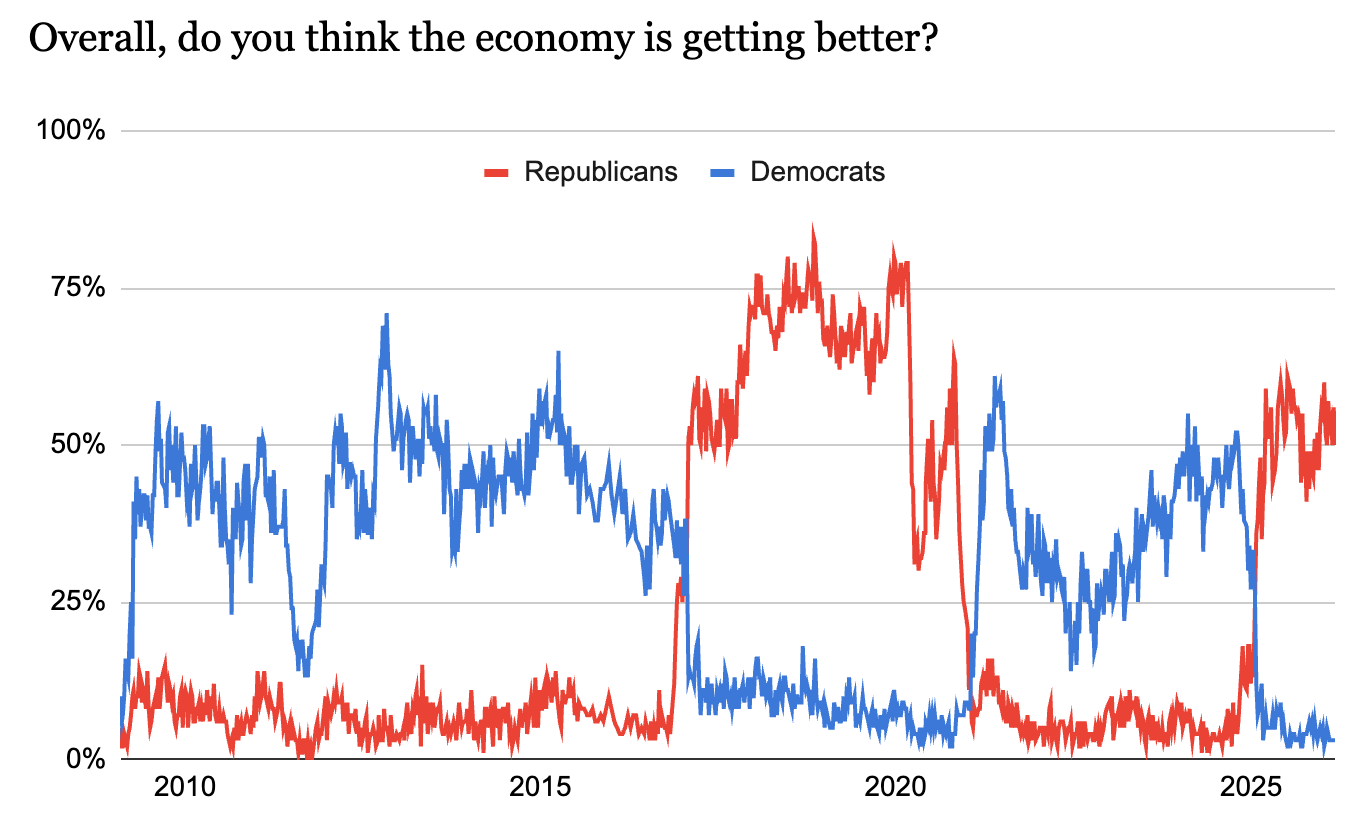
Every week for the last sixteen years, YouGov, a market research firm, has asked about a thousand U.S. voters if they thought the economy was getting better or worse. And for every week for sixteen years, except one, Republicans said yes more often than Democrats when a Republican was president, and Democrats said yes more often than Republicans when a Democrat was president.2
Though this is a very well-known and well-documented phenomenon, it is also (probably3) pretty petty and dumb too. Because, “it’s the economy, stupid”—but the economy is our pre-existing politics. And to the extent that the economy dictates how we vote, it seems to do so in convoluted and self-referential ways, where our perceptions of the country are more defined more by the person in charge of the country than by the country itself.
Ok, sure sure sure, but polls are just vibes. Sports are a construct and polls are vibes. What people say is not what people do. There’s a difference between cheerleading and making material choices about their lives. In matters of real importance—in war; in questions of life and death—we’re not like this.
The Wall Street Journal reports:
A ‘Fight About Vibes’ Drove the Pentagon’s Breakup with Anthropic
The AI giant’s CEO Dario Amodei and Defense Secretary Pete Hegseth have contrasting personalities and worldviews. They proved difficult to reconcile in a high-stakes showdown over the future of warfare. …
“This is a fight about vibes and personalities masquerading as a policy dispute,” said Michael Horowitz, a former Defense Department official who worked on AI policy.
The contract controversy involving the Defense Department, OpenAI and Anthropic was the latest round in a long-running and deeply personal feud between the tech industry’s two most important A.I. start-ups and two executives with differing views of how A.I. should be created.
[In a leaked internal memo, Anthropic CEO Dario Amodei] accused Altman—who last Friday reached a deal with the Pentagon to put OpenAI’s models on classified systems—of engaging in “dictator-style praise” of President Donald Trump and “mendacious” messaging around OpenAI’s agreement with the Defense Department. Amodei concluded the memo by kicking OpenAI employees in the shins, calling them a “sort of gullible bunch.”
Look, I’m not saying that sweeping existential questions about the relationships between AI, military force, and government power are being answered by how a handful of middle-aged men feel about each other, but it does seems like sweeping existential questions about the relationships between AI, military force, and government power are at least being influenced how a handful of middle-aged men feel about each other:4
Ultimately, [Emil Michael, the Department of Defense’s chief technology officer] preferred [OpenAI CEO Sam] Altman—who has courted the Trump administration—over Dr. Amodei, the people with knowledge of the negotiations said.
In 2002, Daniel Kahneman and Vernon Smith won the Nobel Prize in economics for their research into the weird kinks that people have in their utility curves. People are not entirely logical about probabilities and uncertainty, they found, and the pair won the prize because of their “analysis of human judgment and decision-making.”
It seems, perhaps, we need an update, and another study into how reality is not mechanically “rational.” Because, more and more, we don’t buy faceless products; we buy from influencers, from companies with celebrity CEOs, who write personal blogs. We get our news from personalities on TV and on TikTok. We’re all influencers now; the self is the platform.
I’m not saying any of this is good, but—in that world, is it still a fallacy to like (or dislike) things based on whoever is on the other side of them? When you believe in nothing, should pettiness not be part of your utility curve? When everything is a game to gamble on—sports are gambling; financial markets are gambling; war is gambling; everything is gambling—should we be surprised when we start choosing our favorites in the same way we choose our fandoms?
The one exception was the week of January 7, 2017. That week, two weeks before Trump’s first inauguration, 26 percent of Democrats said the economy was getting better compared to 29 percent of Republicans. Three weeks later, Democrats were down to 13 percent and Republicans were up to 51 percent.
On one hand, it’s possible that it’s not petty or dumb. People may genuinely believe in their team’s economic policies over the other team’s, and they may genuinely believe that the economy will improve with their team in charge. On the other hand:
The well-documented rise in political polarization among the U.S. electorate has been accompanied by a substantial increase in the effect of partisan bias on survey-based measures of economic expectations. However, the shift in survey-based measures of economic expectations induced by partisan bias does not appear to affect household spending. For example, despite the enormous relative increase in economic optimism among Trump supporters after November 2016, there is little evidence in administrative data sets of a relative increase in spending by Republicans since the election.
Overall, the results are most consistent with the idea that partisan bias in the answers to survey questions reflect partisan “cheerleading” as opposed to a serious assessment of future individual income growth, at least when it comes to actual spending decisions.
A sampling:
Pete Hegseth, on Dario Amodei: “Instead, [Anthropic] and its CEO [Dario Amodei], have chosen duplicity.”
Amodei, on Sam Altman: “I think these facts suggest a pattern of behavior that I’ve seen often from Sam Altman.”
Emil Michael, the senior government official responsible for choosing an AI provider for the US military, on Amodei: “It’s a shame that [Dario Amodei] is a liar and has a God-complex.”
The correct principle is "Can they both lose" but
a) there is a difference between a downright evil team (open history of flouting the idea that these players are supposed to be real college students; I cannot stand the university as a whole) and the principle that the Big 10 cannot have too many teams advance because general ugliness
b) The ADL scorecard is also available to decide who to root for in some cases
you really know how to brighten a mood.... j/k... sort of.