To weigh a watermelon
There are many frontiers.
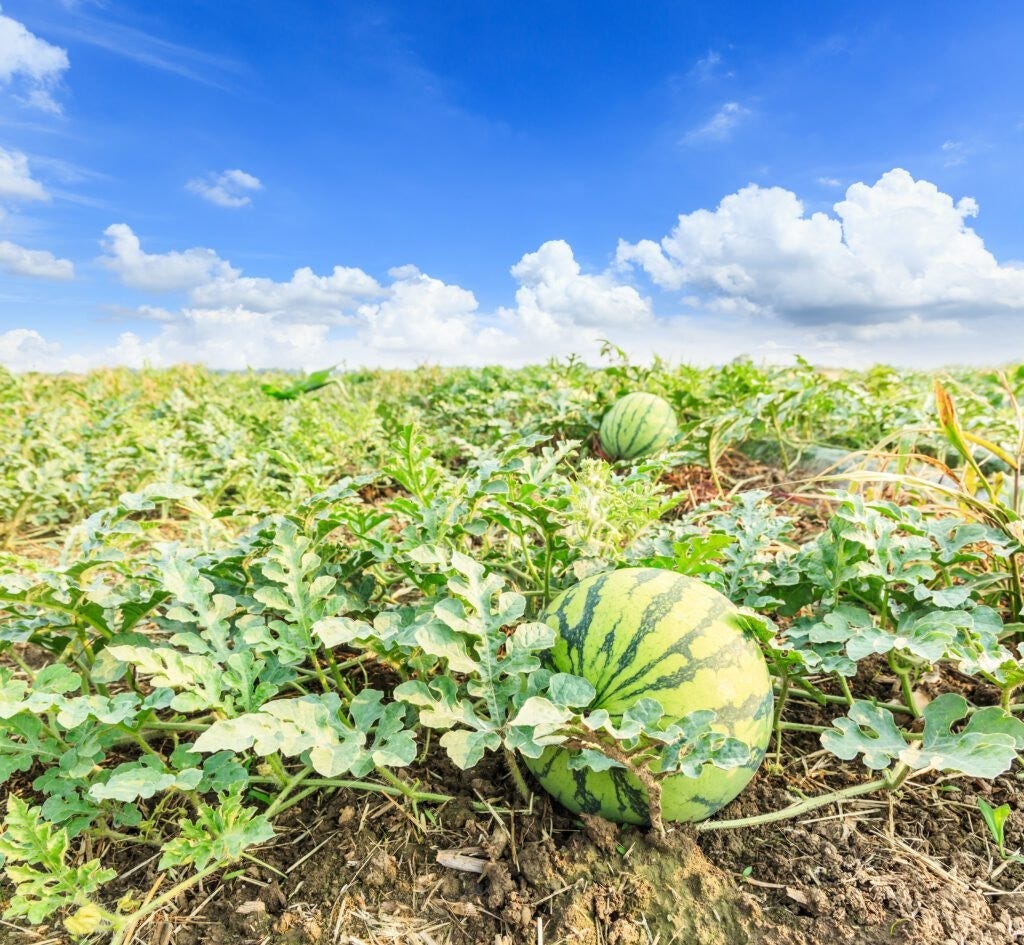
The average watermelon weighs between 16 and 20 pounds. The most common American variety—the Crimson Sweet, which was created in 1963 by Kansas State assistant professor Charlie Hall, following ten years of researching other watermelon varieties, which itself followed millennia of watermelon experimentation and cultivation, beginning, arguably, as early as 2410 BC, in Egypt, where there is the first evidence of people successfully breeding a watermelon that was not bitter, as its early ancestors likely were when they were primarily used to transport water like a natural canteen, but was sweet and eaten as food—is 12 inches long and 10 inches in diameter. If a watermelon were a perfect ellipsoid, calculating its volume would be easy—four-thirds π times the radius of each axis; 628 cubic inches; just over 10 liters. But watermelons are not ellipsoids. Their shoulders are pushed out slightly, more like a cylinder with tapered ends. They are, therefore, superellipsoids. Calculating the volume of a superellipsoid is far more complicated than is worth describing here—it employs several gamma functions, requires deriving a Lamé curve, and figures materially in papers about modeling realistic cosmic dust particles and developing atmospheric reentry paths for reusable space launch vehicles—so, for our purposes, it is sufficient to say that, were we to adjust our formulae to better fit the fruit’s proper geometry, the volume of the average supermarket watermelon would increase to about 11 liters.
Of course, that overstates how much meaningful watermelon there is in one fruit. Watermelons are made up of three strata, arranged in the concentric spheres. From the outside in: A thin green skin, the crust of the orb; a tough white shell; and, after a brief ombré, a red core.1 According to a 2004 study authored by three North Carolina State University researchers and published in HortTechnology, the scientific journal sponsored by the American Society for Horticultural Science, the outer two layers—the exocarp and mesocarp, or, collectively, the rind—is, on average, 0.71 inches thick, with moderate variability across different watermelon types and agricultural regions. Though rinds are edible—the researchers’ study was titled “Rind Thickness of Watermelon Cultivars for use in Pickle Production;” you can also eat rinds raw, in smoothies, salsas, and gazpachos2—most people cut it off and throw it away. Assuming that the width of the rind is uniform around the entire watermelon—it is not, but, we must stop somewhere—the rind represents about 30 percent of a watermelon’s volume, implying that a single watermelon should yield about 7.5 liters of red fruit.3
Critics may say that is an upper limit, though. To separate the rind from the fruit, people often slice the watermelon in half, perpendicular to the longitudinal axis that runs lengthwise through the watermelon. This creates two slightly elongated domes, which are sliced in half again along their vertical axes, producing four quarter-spheres. Each quarter is then stood up one of its flat sides, and sliced into progressively smaller semicircles, the fruit on the inside and the rind tracing the curved perimeter. The semicircles are divided along radial lines into quarters, thirds, or halves, producing various isosceles wedges with the rind bending along the base. Finally, that base is removed, fully freeing the fruit from its shell.4
But almost all of these cuts are approximate. To precisely remove the rind, even from a small wedge, one has to pilot a knife along a long, arching parabola. Moreover, because watermelons are spherical, the rind of a wedge bends in three dimensions, further complicating the ideal path and angle with which one must maneuver their knife. Most people shortcut this effort, and instead cut at the fruit in straight lines, along overlapping chords. This abandons circular segments of fruit in the rind, or leaves small pyramids of rind attached to the fruit, which are often cut off later, with more sharp, straight cuts that are not optimized for the multidimensional curve of the watermelon. In any case, regardless of how it was disassembled, if one was to reconstruct the pieces of a cubed watermelon back into its original figure, the resulting shape would not be a graceful superellipsoid, but a clumsy, many-faced polyhedron, occupying, in all likelihood, less than its full 7.5 liters of potential.5 Let’s round down, then, to seven liters.
We should pause to note, though, that this calculus works because of one of the watermelon’s most remarkable attributes: The inside is made entirely of edible fruit. Most fruits have deceptive and dangerous centers. Avocados have large seeds that consume precious space—and you cannot know just how much might be stolen until you cut it open.6 Peaches have harsh pits that that cling selfishly to the fruit’s interior, forcing the unpleasant choice: Do you pay the pit its pittance and let it keep a few bits for itself, or do you gnaw the remainder off the pit’s sharp, irregular bark, at the risk of grating a lip or chipping a tooth? And apples and pineapples have uncertain cores that, like a disappointed mother side-eyeing the meat left on their wasteful child’s chicken bone, guilt you into eating more of them than you might wish.7
Other melons—the cantaloupe; the honeydew—are partially hollow, and fill their vacuous hearts with seeds and stringy detritus. Removing them is unpleasant business, as is discarding them, because, once extracted, they pile up in disorganized clumps of damp, organic carnage. To eat a cantaloupe, one must first perform a lobotomy.
The watermelon contains no such mess. There are no false walls in its center; there is no filler that the fruit exploits to exaggerate its size. Its interior registers no obstacles, and no gradients of texture. There is no wheat to separate from a chaff; no curds to extract from a whey. It is watermelon, uninterrupted. So pure is the slug of fruit that, if you so choose, you can halve a watermelon into two domes, turn them upside down, and eat them, haphazardly, with a spoon, in any direction you please.8
There are also other, more common ways to eat a watermelon. It can be eaten in bite-sized cubes, best served cold, in the sticky heat of the summer. If cubing the watermelon is too much effort,9 watermelons can be cut into larger trapezoidal prisms, skewered with a fork, and eaten like a popsicle—except, because of the watermelon’s sturdy structural lattice, it is a popsicle that will not wilt or collapse as you eat it.
Or, the watermelon can be served with other ensembles. It can be dressed up with tajin or balsamic vinegar; it can be served in salads of mint and feta. It can be juiced, practically by hand. It can be frozen and blended into a granita; it can be mixed with other fruits and made into a smoothie; it can be shaken into a margarita; it can even be served into a milkshake.
Anyway—to return to the math at hand: What are we to make of the watermelon and its seven liters? The modern actuary would attempt to derive how many calories this represents—1,36110—or how much protein is has—30 grams.11 But that is the math of a nutritionist, or an influencer, or the marketing website of WHOOP, the wearable designed to “unlock human performance & healthspan.” No; we were given this fruit because generations of horticulturalists, from the ancient Egyptians to Charlie Hall, had different ambitions: to bend the long arc of history towards a sweeter, more delicious watermelon. Their sacrifice, then, demands a different question: How much enjoyment is contained in a watermelon’s weight?
The accounting, then, is as follows: A watermelon costs $4.67. According to different studies on the subject, the average adult bite is between 10 and 20 milliliters; 15 milliliters, the size of a chocolate-covered cherry, is a fair midpoint. Seven liters divided by 15 milliliters is, in a precise bit of magic, 467 bites—exactly, then one penny per bite.
Strawberries cost about $2.60 per dry pint; a dry pint contains 28 bite-sized strawberries—nine cents per bite. Bananas,12 a criminally cheap fruit, cost about 17 cents per banana, or, at eight bites per banana, a little more than two cents per bite.13 Apples are about 40 cents each,14 and mangos are about a dollar. It does not take anywhere near 40 bites to eat an apple, or 100 to eat a mango.
The Economic Research Service of the US Department of Agriculture summarized it similarly: Across all fruits, including in forms canned, dried, fresh, frozen, and juiced, the watermelon offers the most volume per dollar spent—and thus, one must conclude, the most moments of enjoyment.
But even this underestimates dominance of the watermelon. Because before a fruit can be eaten, it must be shopped for, and most fruits are a gamble. Peaches start tough and flavorless; for 20 minutes, they are perfect; then, they are mealy garbage. A box of blueberries, raspberries, or blackberries is a game of roulette—a third of the chamber is storybook sweet; two-thirds are harsh bullets of bitter, seedy flesh. The occasional melon is divine; most are not. A dollar spent on an avocado may be a dollar spent on excellent guacamole, and it may be a dollar spent on a stone.
Watermelons are far more forgiving. They do not ripen off the vine, so expert farmers can elect when they are ready;15 they have a long shelf life, so we do not need to cautiously time their purchase; roughly 20,000 tons arrive in stores in the United States every day, so they are always available. We simply go to the supermarket, retrieve a big ball from the bin—but not too big; the Crimson Sweet was also bred to be smaller and weigh just enough to be manageable; yet another unseen breakthrough behind the grocery store’s shelves—and eat it, in whatever manner we please, at the price of one penny per token.
Though, look, see—doesn’t that last bit ruin it some?
You are no doubt wondering: What color is watermelon? According to the makers of Figma, the popular design application, watermelon is a “cheerful blend of pink and green,” albeit, apparently, in the same way one could argue that beige is a blend of white and neon yellow. Mango is orange and yellow—also the color of the fruit’s interior—as is, probably, peach. Pumpkin, however, is the color of the vegetable’s exterior, and so is pear; presumably, apple and banana would be as well (imagine, opening a can of banana paint and it being white). Melon is understandably tricky—it could be arguably be orange like a cantaloupe, green like a honeydew, or light brown like both fruits’ exteriors. So, naturally, it is pink.
Or, since it is 2026, you can also eat it for the content.
Together, all three parts of the watermelon—the exocarp, the mesocarp, and the endocarp, which is the red stuff—are called a pericarp. Peaches are also pericarps, though its endocarp is the pit, and its mesocarp is the soft part that we eat. And apples contain pericarps. All three carps are in an apple’s core, while the body and skin of the fruit is derived from the flower that initially blossoms around the pericarp.
Or, if you prefer, you can leave the rind on, and use it as a handle, like the crust of a slice of pizza. But the watermelon handle is superior to the pizza handle, because the watermelon handle does not need to be eaten. It is purely vehicular, freeing the eater up to pick up other things with that same hand—a summer drink, a child, a baseball—and return it to the watermelon, without worrying about what might be transferred along the way. Moreover, when eating a watermelon directly off its crust, the arch of your bite fits into the curve of the watermelon better than a straight knife, thus removing more fruit, via a kind of circular Riemann sum optimization.
The National Watermelon Promotion Board recommends removing the rind by peeling it. Start by cutting off the ends of the watermelon to create a flat surface; then, stand the watermelon up on one of the ends, and run a knife along longitudinal arcs, from top to bottom, to fully remove the rind. You will then have one giant block of watermelon; cut the block into slices, and cube the slices. According to the NWPB’s research, this method allows a watermelon to be sliced faster than other methods without sacrificing any yield.
It must be admitted, though, that removing the avocado pit, by whacking it with a knife and feeling that satisfying thud, is delightful.
The honorable amount of apple to eat is just beyond the threshold of pleasantness; the ethical amount of pineapple to eat one bite of hard fiber and one burr of skin.
The watermelon’s quick transition from fruit to rind serves this method well. As soon as you hit the bitter edge of the rind, the fruit toughens up agreeably, offering a natural guardrail for a wandering spoon. This compares quite favorably to a coconut, which, if scraped carelessly, will return splinters of bark.
Though it would be dishonest to claim that cubing a watermelon requires no work—there are all those curves and angles—it is, as far as chopping stuff goes, an oddly satisfying chore. The fruit of a watermelon offers just enough resistance against a knife to please the blade, but never so much as to frustrate it. You do not need to push through the fruit, like you might when chopping a potato; it can be cut without a sawing action, as bread demands; the blade does not need to be wiggled against the block to separate a stubborn final peel, as is often asked of a knife when challenged by an apple. And the rind can be cut by everyday equipment, whereas the coconut requires a machete.
Seven liters is 29.59 cups; according to the US Department of Agriculture, one cup of watermelon contains 46 calories. The product of those two figures is 1,361—and almost identical to other estimates.
One cup of watermelon has one gram of protein.
Bananas are the one fruit that can rival the all-around performance of the watermelon, though that is mostly accomplished because banana is not only a top-five flavor (along with maple, ginger, vanilla, and sweet potato); it is the top flavor.
Bananas cost 65 cents per pound; one banana weighs 118 grams; do the division, and it’s 17 cents per banana.
Apples cost $1.30 per pound, weigh 140 grams, and therefore cost 40 cents each.
They do so by examining the fruit and the plant. The NC State horticulturalists harvested their watermelons by “looking for a dried tendril nearest the fruit, a light-colored ground spot, and the dull sound of the fruit when thumped.”
I laughed at the penny-per-token landing. The whole piece builds the most loving measurement of a fruit anyone's ever done, just to show that the metering itself is what ruins it.
I kept expecting the watermelon story to be a metaphor or to end with a transition into an ai or data industry article the way they often do. Definitely feel that I missed something with the token reference at the end.