Something in the orange
A last exit.
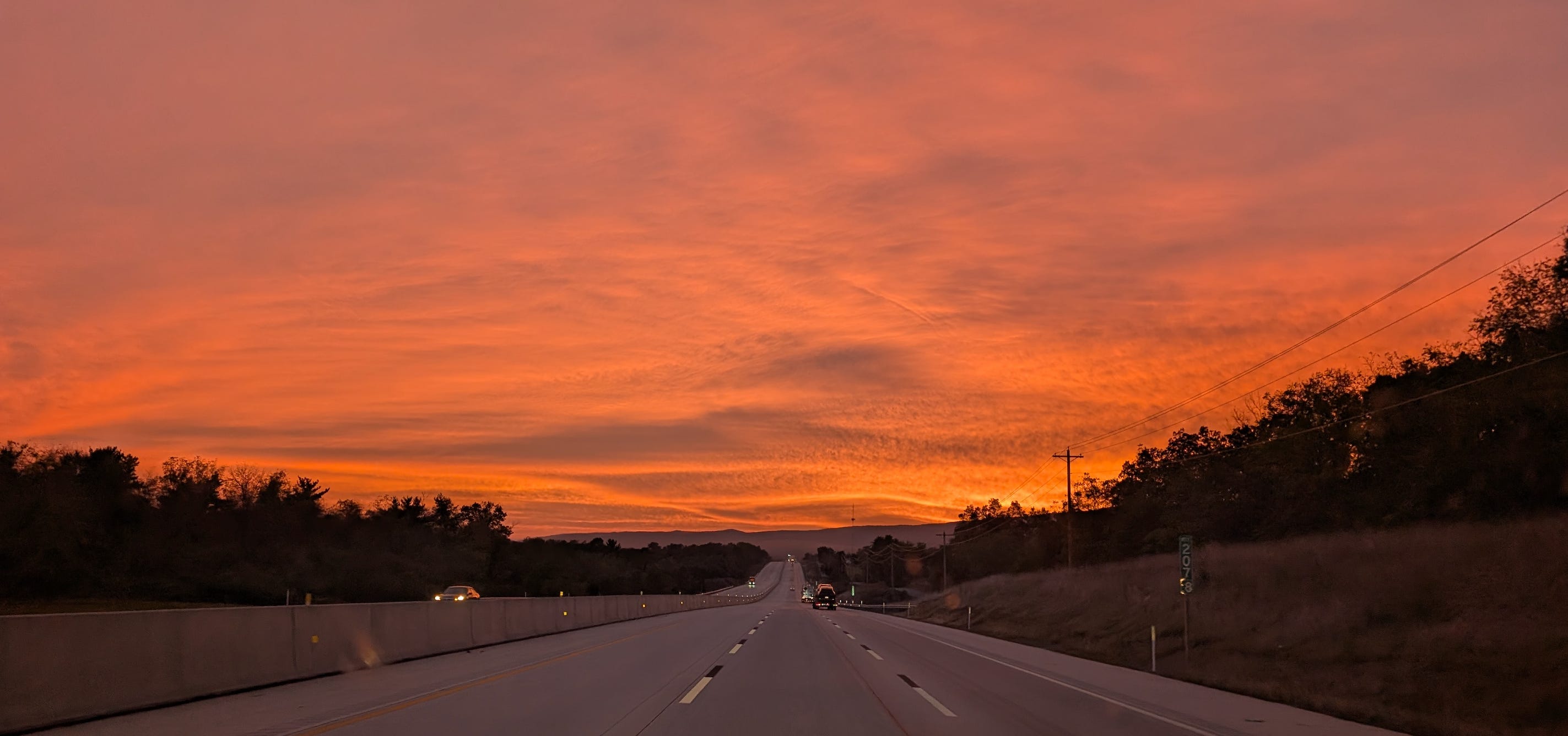
I think about the interstate sometimes. Between San Francisco and New York, between New York and Los Angeles, between Los Angeles and Philadelphia and New Orleans and every other city in the United States, there is an uninterrupted artery of pavement. Pick any two points on a map, and they are not only connected by a single, spidering blacktop; but you can also draw a line from one to the other without ever encountering an obstacle, a stop light, or even an intersection. Somehow, despite millions of people crisscrossing the country every day, there is always a path to go from where you are to where you are going in one long, continuous sprint.
There is an metaphor here, if you want to make one. Startups, despite having a name that suggests a beginning—which seems to also imply the existence of an end, or at least, an evolution—are often one long, continuous sprint. Go fast, forever. Those who find themselves on that highway, they know the feelings that it shares with those of a road trip: There is a destination—an IPO, an acquisition, the promise of peace in two weeks—but it always seems to stretch just beyond the curve of the horizon. Are we there yet? We are perpetually halfway there; it is still day 1; we are only two percent done. There are mileage markers, like fundraising rounds and big hires, that tease our progress. There are pockets of debilitating traffic that wear us down; there are near-miss accidents that nearly kill us; there are stretches of open road and a whole lot of speed; and there are, most of all, hours of absolutely nothing, and the grind of an empty, exhausting drive.
But there is something more subtle about roadtrips, and about startups: Their stories don’t translate. So much is lost in the telling. The misery of inching through clouds of tar and construction dust does not sound, in the grand scheme of things, all that miserable. The barreling mountain wind loses its divinity, when you put it into words. The Colorado sunset does not fit on an iPhone.
But if you were there, in the car, you would understand. You would’ve also wondered if we were going to die in that slug of traffic. You would’ve seen that canvas of a thousand shades of orange, stretching into the cosmos. And you would’ve also felt how the road bends time—how the last thirty minutes before the hotel feels like three hundred; how quickly a sun rises and how slowly it sets; and how, amid the hypnotic hum of the engine, the hours detach themselves, and you become a loose photon, blasting down a timeline all your own.
So it is with startups. From the outside, the hard parts look easy, because, in the grand scheme of things, they are. The successes look mundane, because there are always other companies that are growing bigger, moving faster, and raising more. The time inside a startup passes the same as the time outside of it, because we are all bound to the same ticking clock. And yet, if you were there, inside of that furious, fitful machine, you would understand. You would know that none of that is true.
I towed a trailer from New York to Austin this week. There was a public service announcement on the highway: “Slow down, you’re in Texas already.”
A good offer, when you’re tired. You’ve been going fast for what feels like forever; the highway goes on forevermore. You can only drive for so long. Eventually, you need something more stable. Eventually, you need to find more solid footing. Eventually, you are excited for a simple melon party with a few good friends.
It is all a metaphor, of course.
You’ve probably seen the rumors by now. I don’t know if they’re true, and even if they are, deals can always fall apart. The final signature that made Mode’s sale to ThoughtSpot official came exactly 37 minutes before the press release was published. Startups are more resilient than we often assume, but mergers and acquisitions—those are frail things.
Still, perhaps that will be the conclusion to this story, to this whole story: dbt Labs—the startup that defined a minor technological epoch; the one that hammered its particular will into the professional world; the company around which hundreds more revolved—will end up owned by Fivetran, its long-time sibling.
If it happens, two things are inevitable. First, there will be corporate blog posts about continuity and carrying on. People will be excited to announce that they are joining forces, deepening partnerships, and going further, together. This is not a new direction, someone might say; this is just a bolder destination.
And second, those posts won’t matter. Fair or not, the tech world will close its book on dbt Labs: $400 million raised, 5,700 customers, somewhere north of $100 million in revenue, and $5 billion exit to a sensible partner.
By all reasonable standards, a huge success, for many people. But nothing is particularly reasonable here, especially now. And Silicon Valley’s scoreboard doesn’t care about absolutes; it cares about derivatives: “We don’t value people by where they are. We value them in the same way we value our companies—by how fast they’re rising.”
Five years ago, the market valued dbt Labs at only slightly less—or, potentially, slightly more—than $5 billion. Snowflake, a close dbt partner, was worth over $100 billion. Venture capitalists said that both companies sat at the center of a trillion-dollar opportunity, and dozens of huge companies were left to be built. There was something in that orange—the sort of promise that happens once every few lifetimes.
Now, the modern data stack is a punchline. The trillion-dollar data market has already been replaced by an AI market that’s five times as big. Billion-dollar companies are everywhere, and the decacorn is the new unicorn. Five billion dollars? Ho-hum.
And so, there will be critics. There will be autopsies. There will be detached cynicism and views from nowhere. There will be references to the line about dying a hero, or living long enough to become the villain—about dbt Labs drifting away from its core; about the commercialization of a community; about the perils of venture capital; about consolidation; about the end of an era, or an idea, or an ecosystem.
But there is another, quieter version of the Batman quote: If you live for long enough, nobody is left to give your eulogy. The people who started the trip with you get bored or tired or unhappy, and the only records left are feeble photographs and fading memories, and stories that never sound like they felt. And you begin to wonder, if nobody else remembers it, did it happen? Did it count?
But I was there, for a bit. Many of us were—on the road, in the caravan, some of you were in the car. And though we may now be old and wise—or old and bitter—we were not always that way.
Do you remember it then? Do you remember when the road felt full of promise? Do you remember how it was before they built what they built?
When I was in school, technology had no particular appeal to me. I ended up here—in Silicon Valley, in data, at Mode—by chance. But once I found myself in San Francisco, I stayed for much longer than I ever meant to. And when my trip with Mode ended, I told its good people why I had stayed:
At the end of Charlotte’s Web, Charlotte the spider says to Wilbur the pig, “You have been my friend. That in itself is a tremendous thing. I wove my webs for you because I liked you.”
I probably should say that I worked at Mode to accelerate human reasoning, or to make the world a better place, or whatever. And in some loose sense, I guess that’s true—I wanted to make something that mattered, to get rich and famous, and all of that.
But in reality, I worked at Mode for a more basic reason. I started it with Derek and Josh because I liked them. And I wove my webs here because I liked all of you. For ten years, through disastrous days and calm ones; through good quarters and bad; through layoffs and acquisitions; through highs and lows and the everyday drudgery of corporate administrivia and company building, all of you have been my friends. And no matter what is next, that in itself has been a tremendous thing.
And so it’s been, with my time in this industry, and with many of the people at dbt Labs. No matter what happens next, you have also been my friends. I do not know if that is enough of a narrative for you, but it is enough of a narrative for me.
Next week, I’ll go from Austin to Las Vegas. dbt Labs is hosting their annual conference, and we have things to share.
Though I drove here, I will fly there. I made it as far as I could, but could not make it all the way to Las Vegas. It was further than I was able to drive. Like most people, I need a shortcut to the end.
Off the planes, we’ll no doubt whisper about dbt Labs’ future. Is this where their trip ends? There is so much more highway left ahead of them. From Fishtown to Las Vegas—could they make it to LA? Up to Seattle? All the way back to New York?
Maybe; I don’t know. But who are we to judge life on the road when we came here in the air?
There is a Lowe’s distribution center a hundred miles east of Dallas, just off of I-30. Giant letters are woven into the fence that sits between the facility and the highway: “Who is counting on you to come home safely today?”
When you’re on the highway, it is easy to chase what is in front of us, and forget what—and who—is waiting behind us. It is easy to get absorbed in our ambitions and ourselves, and to forget that someone wants us home. Adventure, for a while. But eventually, a quieter home. A mountain house; a view of the late fragments of sunset light. A small boat and a big lake. A room for movies; a fire place; an ice maker; a nice set of speakers; a few kids running around.
It is an easy exit to miss, on the madness of this highway. But as deserved as it is worthy, if you found it. You can pack a lot of glory into a car, but you cannot fit the good stuff.
This was so tastefully tender
What I love the most about this beautiful reflection is how I know this will shift over the years. You can feel it already, that this is a mid point not an end state. A specific kind of clarity that will later look like only a piece of the story.